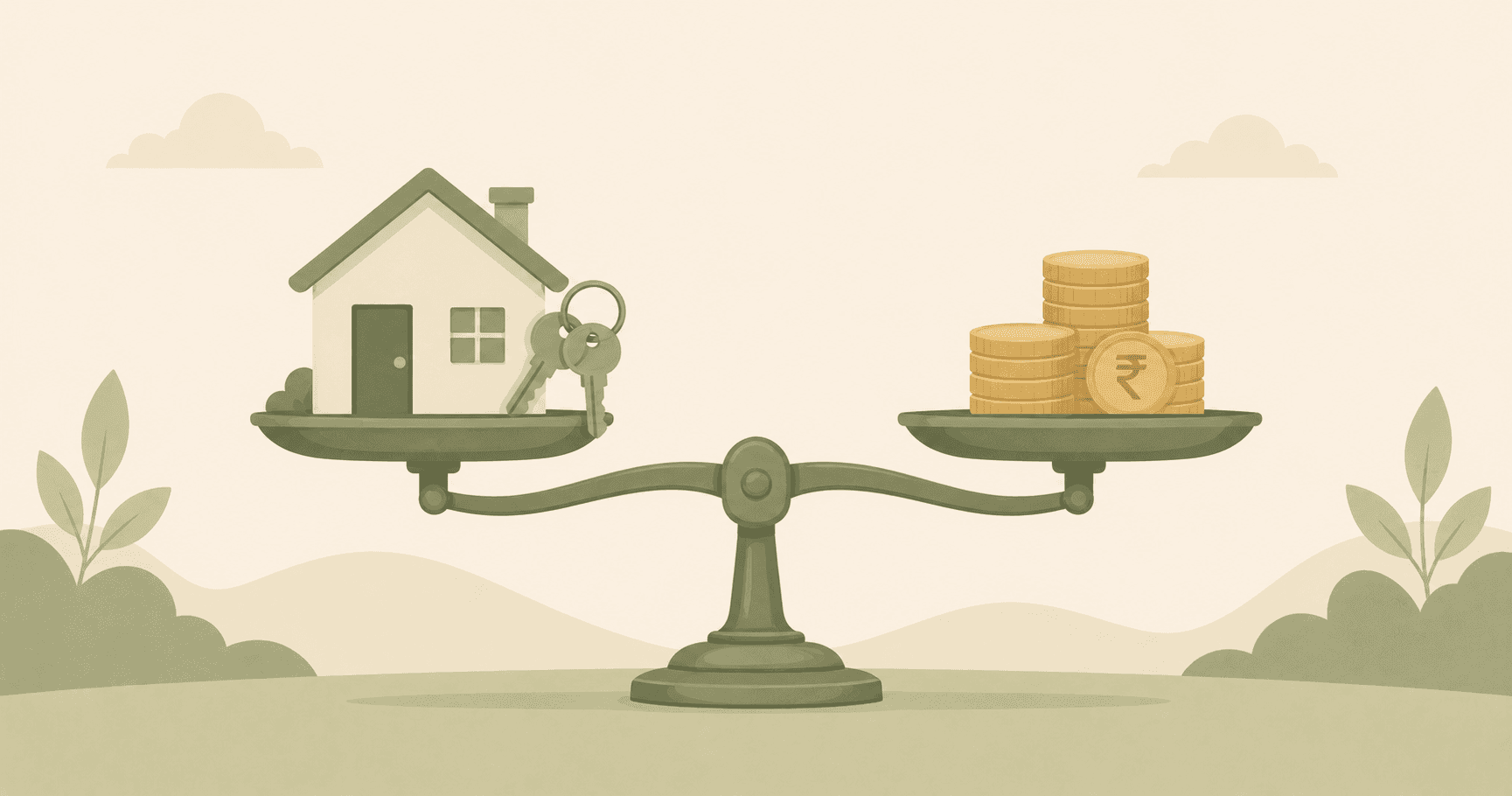
It's Not Just 'Rent Is Wasted Money'
Almost every Indian household hears some version of this at some point: renting is throwing money away, while an EMI at least builds an asset. It sounds airtight, and it shapes a huge number of decisions — often the single biggest financial decision a family makes.
But this one-liner skips almost everything that actually determines whether buying is the better move. A home loan comes with interest, which is also money that leaves your hands and never comes back to you. A down payment is money that stops earning returns elsewhere. Ownership brings maintenance, property tax, and repairs that renting simply doesn't. None of that means buying is wrong — it means the comparison deserves real numbers, not a slogan.
The Down Payment Has a Job Too
This is the part most people skip entirely: your down payment is capital, and capital has an opportunity cost. If you put ₹20 lakh into a home down payment, that ₹20 lakh is no longer available to invest in equity, mutual funds, or anything else that could compound over the years you'd otherwise be renting.
The same logic applies to the gap between rent and EMI. If your EMI is ₹15,000 more than the rent you'd pay for a similar home, and you chose to rent instead, that ₹15,000 a month could be invested. Over 15-20 years, that difference — invested consistently — can grow into a substantial sum. A fair rent-vs-buy comparison has to ask: what would this money have become if it had gone into investments instead of into a home?
The Real Cost of Owning
The EMI is the visible cost, but it isn't the whole cost. Add up interest paid over the loan tenure (which, in the early years, is most of your EMI), annual property tax, society maintenance, repairs, and eventually renovation. Owning a home is a bit like owning a car — the purchase price is just the start.
Renting has its own downsides, mainly the lack of stability — landlords can ask you to vacate, rents can rise, and you never build equity in the property. But renting also comes with real flexibility: no maintenance bills, no property tax, and the freedom to move cities for a job without selling anything.
Then there's appreciation — the assumption that your home's value will keep rising. This is where a lot of the 'buying always wins' intuition comes from, and it's also the least predictable variable in the entire decision. Property appreciation varies enormously by city, locality, and time period, and past appreciation in one pocket of a city says very little about the next 15 years in a different one.
A Simple Example
Say a 2BHK in a given locality costs ₹80 lakh to buy, or ₹25,000 a month to rent. Buying means a ₹16 lakh down payment (20%) and a ₹64 lakh loan at 8.5% over 20 years, which works out to an EMI of roughly ₹55,500. Add maintenance and property tax, and the real monthly outgo for the owner is closer to ₹58,000-60,000.
The renter pays ₹25,000 a month and invests the difference — roughly ₹33,000-35,000 every month — plus the ₹16 lakh they didn't put down, into a mutual fund or index fund. If that investment grows at even a moderate long-term rate, the renter's portfolio after 15-20 years can end up surprisingly close to, or sometimes ahead of, the equity the buyer has built in the flat, especially in cities where property appreciation has been modest.
This isn't a verdict that renting wins — it's an illustration that the outcome is genuinely close, and tips one way or the other depending on assumptions you can actually control and check.
Why There's No Single 'Right' Answer
The result of this comparison is extremely sensitive to a handful of assumptions, and small changes to any of them can flip the conclusion entirely. City matters enormously — rental yields in Mumbai or Bengaluru are very different from Tier-2 cities, and property appreciation history varies just as much. How long you plan to hold the property matters too: buying tends to look better the longer you stay, because loan interest and transaction costs get spread over more years, while renting can look better if you expect to move within 5-7 years.
Expected investment returns are the other big lever. If you assume your alternative investments would grow slowly, buying looks much more attractive. If you assume steady long-term equity-like returns, renting-and-investing looks a lot more competitive. Since nobody can predict either property appreciation or market returns with certainty, the honest answer is that the 'right' choice depends on your own city, timeline, and risk appetite — not on a universal rule.
Beyond the Spreadsheet
It's worth saying plainly: this decision isn't purely financial, and it shouldn't be. Owning a home brings stability, the freedom to renovate as you like, and a sense of security that many families value regardless of what the numbers say. Renting offers mobility and flexibility that matter if your career or life plans are still taking shape. Neither of these is something a calculator can price in for you, and that's fine — the math is meant to inform the decision, not replace your judgment about how you want to live.
What the math can do is stop the decision from being made on a slogan. Once you can see your own numbers — your city's rents, your likely loan rate, your holding period, your alternative investment returns — you're deciding with information instead of a hunch.
If you want to see how this plays out with your own numbers instead of the illustrative example here, try finkit's Rent vs Buy calculator. Plug in your city's rent and property prices, your expected loan terms, and your investment return assumptions, and see which side of the line you actually fall on.
FIRE in India: What It Really Takes to Retire Early
What FIRE actually means, how to estimate your own FI number, and why it looks different in India.
5 min read
Debt Snowball vs Avalanche: Paying Off Loans the Smart Way
Two proven strategies for clearing multiple loans faster, one built for motivation and one built for math.
5 min read
Inflation Is Quietly Eating Your Savings — Here's the Fix
Your bank balance can grow every year and still buy less — here is why, and what actually protects it.
5 min read